

Researching food sustainability policy for the Federal Office of Agriculture and a scientific career in nutrition and health have led me to one conclusion: our food systems are harming both human and planetary health. We need solutions that will shift them into life-affirming systems—ones that support the thriving of human and non-human beings.
But, in my opinion, the “solutions” conversation tends to split into two camps: either a return to traditional values and Indigenous ways of relating to the Earth, envisioning a kind of post-tech utopia, or full-steam innovation mode, powered by the conviction that we’ll engineer our way out of the mess we’re in (even though innovation arguably got us into it).
Returning to a reciprocal relationship with the land—rooted in respect, observation and investment in soil health—is an important way to farm. Beyond the climate-stabilizing effects of healthy soil and thriving biodiversity, scientific research shows this kind of production yields more nutrient-dense food and tends to preserve farmers’ own health in ways industrial agriculture doesn’t.
On the other hand, due to human population growth amid an ever-warming climate, it’s a real concern whether we’ll be able to produce enough food between now and 2050. In fact, some research suggests that a wholesale switch to regenerative, agroecological production may not feed everyone—a realization that is hard to reconcile with nature-rooted, tradition-based solutions.
On top of that, agroecological production at the scale that we need would use a lot of land. Award-winning agriculture journalist Michael Grunwald has argued that one of the most powerful climate interventions available to us is to use less land for food, not more, and rewild what we can. He suggests that we should be focusing on getting as much yield as possible in as little agricultural land as we can—a path that would require pretty serious innovation.
This tension is why, I believe, we need to strike a middle path between the two visions of how our food systems should evolve. In this middle path, tradition plays an important role, but so does innovation.
This past month, Startupticker—a news platform where I work as a journalist—covered a slew of new solutions pioneered by Swiss food startups and companies that I’d like to highlight. What I find interesting is how these new approaches create bridges between technological innovation and traditional thinking. While these solutions are in early-stages and still need to prove their added value in the long term, they nonetheless offer a glimpse into a functional future food system.
Robots to the rescue
Late-night shifts aren’t good for fast food workers’ health, especially given how underpaid they are—yet consumer demand for late-night meals isn’t going anywhere. Pazzi’s fully automated pizzeria in Madrid is one attempt to solve this issue, by having robots handle the kitchen end-to-end.
The same logic applies further up the supply chain. Farming is back-breaking work, and farmers tend to catch a lot of flak despite devoting their lives to feeding the rest of us. Companies like Ecorobotix—which manufactures an ultra-high precision pesticide spraying robot for use in large cultured fields—make it easier to imagine a future where farmers and the land are better respected, while still producing enough to feed everyone.
Waste nothing
Reducing food waste is one of those rare food system solutions that everyone can get behind. The startup accelerator StreamUp launched its second cohort with nine companies developing projects that either find ways to market byproducts from food production or rescue food from being wasted altogether. They will showcase their solutions in June at the Focus Food Save event in Bern. Meanwhile, the company ProSeed, which appeared in this month’s Swiss Food & Nutrition Valley investor showcase, takes a similar approach: transforming wet by-products from food processing into food-grade ingredients. They’re currently focused on spent grain, the leftover solids after beer is brewed, and okara, which is created during tofu production—two streams that are still largely wasted.
Foods of the future
The company Cosaic raised $6 million for its next-generation vegan ingredient Cosaic Neo, a creamy milk alternative produced via yeast fermentation. Meanwhile, the company Planetary closed CHF 22 million to build out its global fermentation infrastructure and licensing platform, which serve foodtech companies focusing on alternative proteins such as plant-based meats.
Two more startups from the investor showcase caught my eye: Aleph Farms, which recently opened a subsidiary just outside of Zurich, is developing lab-grown beef as a way to keep meat on the menu without the planetary and ethical costs, and Neocarbons, which is growing microalgae to turn into products such as animal feed—a category responsible for a meaningful chunk of agricultural CO₂ emissions. Neocarbons claims to have a net-negative carbon balance.
Plant-forward
Scientific research keeps reinforcing that resilient food systems need to be built on a plants-first foundation. From the same investor showcase, I was intrigued by a number of companies working to find sustainable, plant-based alternatives to animal products that have far less impact on the environment. For instance, Catchfree is developing plant-based fish substitutes, while Eggfield is making plant-based alternatives to eggs and Fabas is crafting dairy products from beans. Meanwhile, Food Brewer is making sustainable cocoa and coffee (yes, in Switzerland), Sentianova is working to ensure that plant-based proteins actually taste good, while Trilliome is exploring ways to make our guts healthier through upcycled plant-derived compounds.
These companies are all working to find solution so that we can keep enjoying the foods we love, with far less impact on the environment, by rebuilding them from plants.
Smarter agriculture
Agriculture is in a bit of bind. It’s simultaneously a huge source of emissions, while being profoundly necessary. On top of that, maintaing stable crop yields is getting harder on a warming planet, causing farmers to have to double down on harmful practices to ensure they produce enough food. Innovation in this vertical is direly needed.
Ecorobotix earns a second mention here; their high-precision pesticide spray technology dramatically reduces the amount of product applied per field, while also improving labor conditions for farmers exposed to the chemicals. Meanwhile, companies like Voltiris have created solar panel modules that allow the wavelengths of light that plants need to grow to pass through while harvesting the other wavelengths to generate electricity, helping to make greenhouses more energy independent.
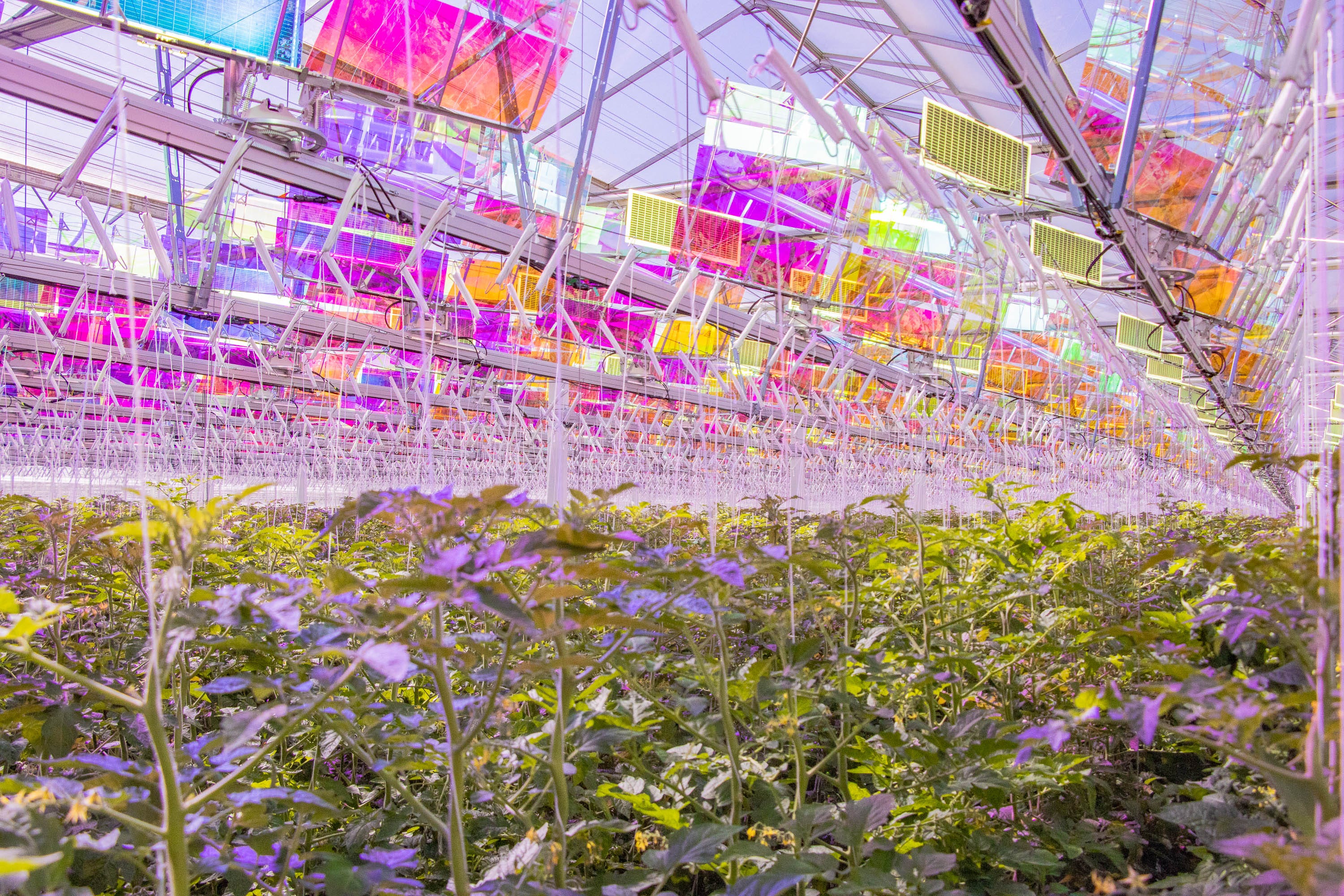
Meier Gemüse project: the world’s first hectare-scale spectral filtering solar installation, a tomato greenhouse in Switzerland operating under nearly 2,000 Voltiris solar modules. Image courtesy of Voltiris.
Better packaging
Most of our food comes packaged in plastics, a harmful material that needs no introduction. From this investor showcase: The company Agrosustain has developed a safe packaging-type material, which they call a biobarrier, that keeps produce fresher for longer after harvest—addressing one of the larger sources of food loss, i.e., everything that happens between harvesting and buying produce at the supermarket.
Another company that caught my eye is B’ZEOS, which is making packaging from seaweed instead of plastic.There are a myriad of benefits, but perhaps one that stands out today is that the new packaging doesn’t leak microplastics, which scientists are increasingly finding is making its way into ecosystems as well as our own bodies. While the consequences aren’t yet fully clear to scientists, some studies suggest that microplastics decrease the effectiveness of photosynthesis in plants and, worryingly, show up at high concentrations in the brains of dementia patients.
Building Bridges
What I find particularly interesting about many of these solutions is that they’re working towards a “middle path” approach, where deep-tech engineering meets respect for the health of the land and the people it serves. For example, Ecorobotix claims it’s able to reduce the amount of pesticide used by 95% with their ultra-high precision spray technology, an innovation that directly supports soil health, which is suffering globally from the overuse of these chemicals. And by creating products that keeps organic harvests fresher for longer, companies like Agrosustain are reducing food waste that results from spoilage. Limiting food waste is a powerful lever of change, as we already produce enough calories to feed the world but waste up to 30% of it, putting more pressure on the land to produce excess food that we don’t actually need.
It also gives me hope to see start-ups like Fabas finding bean-based alternatives to products from the highly-polluting dairy sector; while at the same time, saying they’re committed to working directly with local farmers and helping them transition towards bean production. By creating demand for locally grown pulses, farmers can diversify their income sources, making their livelihoods more sustainable. Beans are a great way to do this, as this crop also fixes nutrients like nitrogen back into the soil. And by crafting a tasty product—I had a chance to try it and can confirm it really tastes like dairy—it encourages consumers to vote with their dollar for sustainable alternatives.
Approaches like these suggest that we can find sustainable ways of confronting the challenges that face our global food systems. When tradition and innovation support each other, they become more than the sum of their parts—the foundation of a food system that serves both people and planet.